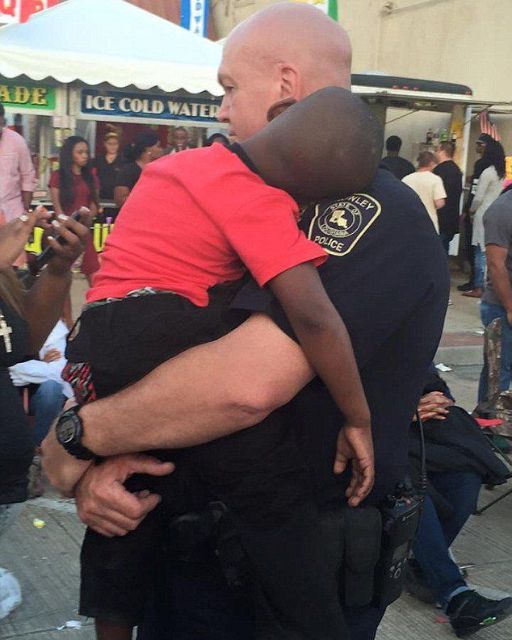
They weren’t talking about Zavi falling asleep. They were talking about who was holding him—and what it would’ve looked like if things were even slightly different.
And now I can’t stop wondering… Would he still be safe if he didn’t look so small, so harmless, so tired?
The question hung in the air, heavy and unsettling. It burrowed into my thoughts, replaying the scene in my mind. Officer Davies, that was his name, had been genuinely kind, a reassuring presence in my moment of sheer terror. He’d handed Zavi over with a gentle smile, a brief explanation, and that was it. End of story, right?
But the whispers, the glances, the comments – they painted a different narrative, one layered with the complexities of race and perception. What if Zavi had been older, taller? What if he hadn’t been asleep, but just wandering, maybe a little confused or scared? Would the interaction have been the same? Would Officer Davies have approached him with the same calm demeanor? Or would suspicion have colored his actions?
That night, sleep was elusive. Every time I closed my eyes, I saw Officer Davies holding Zavi, but the image kept shifting. Sometimes, Zavi was giggling, reaching out to touch the officer’s badge. Other times, he was fidgeting, his small hands moving in a way that could be misinterpreted. And in those darker imaginings, the officer’s face was harder, his grip tighter.
The next day, I couldn’t shake the feeling. I talked to my sister, Zavi’s mom, about it. She’d heard the whispers too. We’d both seen the looks. And we both knew, deep down, that the color of Zavi’s skin played a role in how that moment was perceived.
We decided to do something. Not out of anger, not to cause trouble, but to open a dialogue, to maybe even spark a little change. We posted about the incident on social media, carefully recounting what happened, praising Officer Davies for his kindness, but also acknowledging the undercurrent of racial tension that had rippled through the crowd.
The post went viral. Comments poured in, a mix of support, anger, and denial. Some people accused us of making something out of nothing, of being overly sensitive. Others shared similar stories, their own experiences of how race had shaped their interactions with law enforcement.
One comment stood out. It was from Officer Davies himself. He thanked us for acknowledging his actions but also admitted that he understood the underlying concerns. He said it was a reminder of the work that still needed to be done, the conversations that needed to be had.
That led to an unexpected twist. The local police department reached out to us. They wanted to use our experience as a training opportunity, a way to discuss implicit bias and community relations. They invited us to speak at a town hall meeting, to share our story and our perspectives.
Continued on the next page